Some landscapes speak in whispers. The deserts of Saudi Arabia hum instead — a low, endless sound that seems to rise from the ground itself. For centuries, these dunes and valleys have carried the footsteps of pilgrims, their routes traced by faith rather than maps. Yet today, that same journey feels new again. Sleek trains glide where caravans once trudged, their paths lit not by lanterns but by stations of glass and steel.
It’s not a replacement for pilgrimage, but a reimagining. The spirit of the traveller remains the same — only the rhythm has changed. The heartbeat of the journey now pulses through tracks that cut across golden earth, connecting sacred cities in hours instead of weeks.
Where Every Journey Begins
Jeddah has always been the threshold — the place where the journey begins, where the air smells faintly of sea and spice, and where languages mix like colours in the heat. It’s a city of welcomes. Of arrivals. Of people setting out with hope in their eyes and prayer in their hearts.
The Jeddah Airport to Madinah route now carries thousands every week — families in their best clothes, pilgrims clutching prayer beads, workers returning home. The train glides past the Red Sea’s shimmering edge, leaving the waves behind for the open desert. The change is immediate — the blue gives way to gold, and suddenly the world stretches wide and wordless.
It’s hard not to feel something stir as the desert begins. Out the window, you might catch sight of a minaret, a shepherd, a wisp of dust curling like smoke. It’s not silence — it’s something deeper. A kind of peace that sinks into you slowly, without asking.
The Desert in Motion
From the window of a train, the desert feels alive. Not barren, but breathing — wind carving patterns in sand, sun tracing light across the dunes like a brushstroke. Every few miles, a flash of green signals an oasis. A cluster of palms. A tiny promise of water.
The Saudi Arabia trains move through it all with quiet precision. There’s something meditative about their motion — the hum of steel, the rhythm of tracks beneath your feet. Inside, travellers share smiles and snacks; children press their faces to the glass. It’s travel as it should be: slow enough to see, fast enough to feel.
This modern network isn’t just an engineering triumph — it’s a thread between worlds. It links the old and the new, faith and progress, the tangible and the spiritual.
To the Holy Cities
Makkah and Madinah still anchor the pilgrimage. Their names alone carry centuries of meaning. Yet arriving by train adds another layer — one that feels both intimate and immense. The journey is no longer arduous, but its significance remains.
In the carriage, conversations fall away as the city nears. Some passengers close their eyes. Others whisper du’a. There’s a stillness that feels almost sacred. When the train finally slows and the skyline of Madinah comes into view, it’s as if the whole world exhales at once.
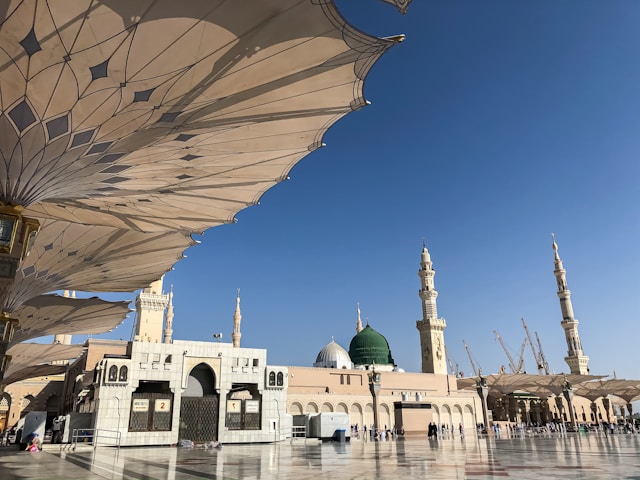
Outside, the air feels different — softer, touched with the scent of palm and incense. The Prophet’s Mosque gleams in the distance, its green dome glowing under the afternoon light.
Madinah: Stillness in Motion
Madinah has a gentleness that seeps into everything. The streets are wide, shaded by palms. The marble courtyards of the mosque gleam like water. Even the sound of footsteps feels hushed here.
People move slowly, purposefully. They greet each other with warmth and leave space for silence. At sunset, the call to prayer echoes through the air, rolling softly over rooftops. The city feels suspended between worlds — earthly and divine, ancient and new.
Visitors often describe Madinah as “a feeling more than a place,” and it’s true. You don’t just see it — you sense it. The peace here doesn’t demand your attention; it welcomes it quietly.
Across the Kingdom’s Heart
Beyond the sacred cities, Saudi Arabia’s land stretches vast and various — red canyons, date groves, volcanic plains, and cliffs that glow like embers at dusk. Once, these were distant worlds, connected only by caravans and courage. Now, the tracks carry travellers farther — to AlUla’s honey-coloured tombs, to Tabuk’s mountain trails, to towns that hum with old stories newly told.
It’s not just infrastructure. It’s invitation. Every line that cuts across the desert seems to whisper: come see for yourself.
The Modern Pilgrimage
To journey here is to understand that faith and future need not stand apart. The railway system — sleek, swift, unpretentious — isn’t designed to replace the pilgrimage, but to enhance it.
The old routes remain in spirit. The reverence, the patience, the quiet awe — they haven’t gone anywhere. They’ve simply found new ways to move. For many travellers, these trains have become symbols of something larger: renewal without rupture, progress without forgetting.
Moments Between Destinations
The true magic of this land often happens between stops. The moment when dusk paints the sand in rose and gold. When the train hums softly in the background and time itself seems to stretch. When the person across the aisle offers dates from a tin and you both smile without needing to speak.
These are the details that stay long after you’ve arrived. They’re small, human, fleeting — but together, they tell the story of a country learning to move forward while staying rooted in grace.
Light, Land, and Legacy
As night falls, the desert takes on another form entirely. The stars come alive, bright enough to guide you even now. The sound of the rails merges with the wind, and you realise that this is what connection really means — not just reaching a place, but understanding it.
The hum of the trains lingers like a heartbeat long after the journey ends. It’s the sound of faith adapting, of people in motion yet grounded by purpose.
In a world that changes faster every day, this feels quietly revolutionary — a reminder that modernity and meaning don’t have to be at odds. In Saudi Arabia, the rails and the road to the sacred run side by side, each carrying the same truth: that every journey worth taking begins not with movement, but with intention.