Some cities pull you in with history, others with beauty — but Europe’s great capitals do both, often in the same breath. They carry an easy elegance, a confidence born from centuries of creativity, culture, and conversation. Yet beyond their grand facades and cobbled streets, there’s a quiet modern rhythm: cafés where artists now work on laptops, trams that glide past medieval churches, and a sense that time here flows both forward and back at once.
To travel between them by train is to move through this blend of eras — from romance to innovation, from the familiar to the newly rediscovered.
Where Canals Reflect the Sky
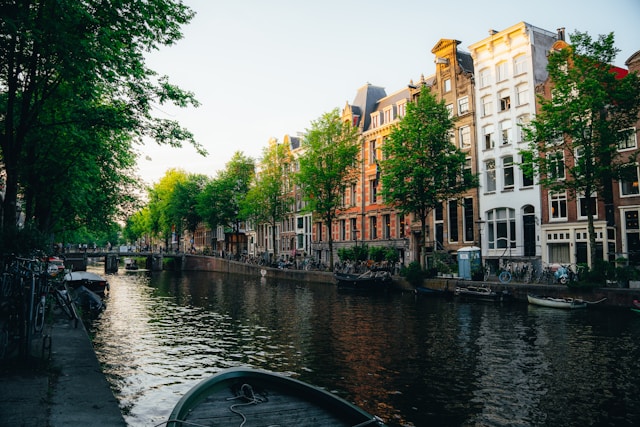
In Amsterdam, the water always seems to steal the show. Even when the sun hides, light bounces off the canals, dancing across gabled houses that lean slightly toward one another, as if sharing secrets. Cyclists breeze past, scarves trailing, bells ringing. The city feels alive but never hurried — a place that values motion without rush.
Leaving Amsterdam is never easy, but there’s something quietly thrilling about the train from Amsterdam to Brussels. It hums southward through the Dutch countryside, past windmills and flat fields brushed with morning mist. The journey itself feels effortless, a soft transition between languages and landscapes. By the time the train rolls into Belgium, the world has changed — more waffles and art nouveau, less water and bicycles — yet the charm remains.
Brussels: Layers of Time
Brussels greets you with contrast. Sleek EU offices stand beside ornate guildhalls, and murals bloom on building walls like oversized postcards. The Grand-Place, with its golden façades, seems to glow at any hour. Yet wander just a few streets away, and life turns local again — a café tucked between antique shops, the smell of chocolate melting somewhere unseen.
There’s a certain tenderness to Brussels. It doesn’t perform; it simply exists, proud of its contradictions. Here, French meets Flemish, politics meets poetry, and art hides in plain sight — sometimes in a comic strip, sometimes in the pattern of tiles beneath your feet.
South to the City of Light
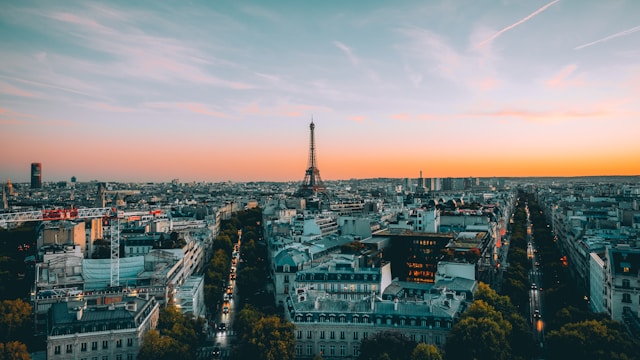
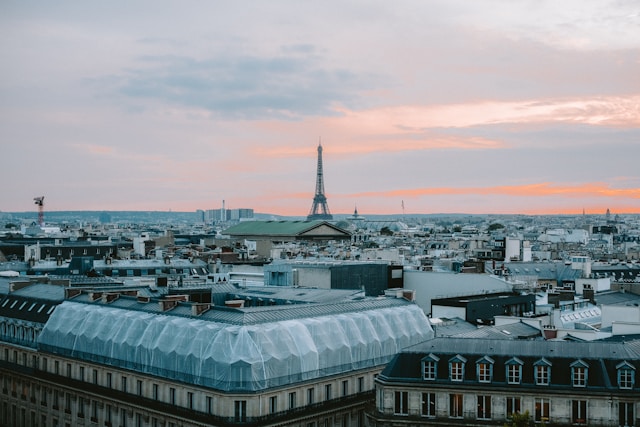
Few journeys feel as timeless as the travel from Paris to Amsterdam, especially when you do it in reverse, tracing the route northward or southward like a thread through history. Paris needs no introduction, yet somehow it always surprises.
Step out of Gare du Nord and the city unfolds with that unmistakable mix of grandeur and intimacy. Boulevards shimmer after rain, the air smells faintly of coffee and croissants, and the chatter of café terraces rises like music. Even the pigeons here seem to move with style.
But Paris isn’t just beauty — it’s a pulse. The Seine cuts through it like a thought, reflecting bridges, domes, and dreams. Lovers lean against the stone walls, watching boats drift beneath the arches. In the evening, the city turns golden, then blue, then alive with light. Each moment feels fleeting yet infinite, as if Paris itself exists somewhere between memory and anticipation.
A Bridge Between Eras
Modern Europe doesn’t cling to its past — it converses with it. In these capitals, technology hums quietly beneath the surface, respectful of the cobblestones above. Trains glide where once stagecoaches rattled; glass rooftops rise above Renaissance courtyards.
Travelling between these cities is as easy as it’s ever been, yet each journey still feels meaningful. You can move from one language to another in under two hours, from stroopwafels to moules-frites, from Dutch restraint to French flair. It’s that nearness — of culture, of contrast — that gives Europe its enduring charm.
The Details That Stay
Every traveller remembers something different. The warm scent of frites in Brussels’ winter air. The soft thud of a suitcase wheel over Parisian cobblestones. The blur of countryside outside a train window, fields stitched together like a patchwork quilt.
There’s romance not only in what you see, but in how you move — the hum of the tracks, the low murmur of fellow passengers, the small kindnesses exchanged without words. Even in this age of instant travel, the train still feels intimate. You can read, think, stare, or simply be — suspended between places, part of both yet belonging fully to neither.
Paris: Where Art Breathes
Art lives in Paris like weather — sometimes visible, sometimes subtle, but always there. From Montmartre’s paint-splattered studios to the quiet hush of the Louvre, creativity feels constant. Street musicians play near the river; students sketch the city that has inspired generations.
Even the smallest moments feel cinematic: a couple arguing softly by the river, a child chasing pigeons, the smell of rain on stone. It’s impossible not to fall in love with life here, even just a little.
Amsterdam Again, in Reverse
Return north and the rhythm changes once more. Amsterdam welcomes you back with open skies and open minds. The trains glide in beside canals lined with houseboats and tulips, and suddenly the air feels lighter. Perhaps it’s the water — reflective, forgiving — or perhaps it’s the sense of freedom that floats here.
There’s modern art in old churches, vegan cafés in former warehouses, and laughter spilling from terraces as twilight settles. The Dutch have mastered the art of balance — between old and new, art and everyday life, structure and spontaneity.
Romance and the Rails
Across Europe, trains do more than connect places — they connect people, moments, and memories. They make travel part of the story rather than a pause between scenes. There’s a certain intimacy in watching a city fade from view, knowing another waits just beyond the horizon.
Each journey feels like a dialogue between eras: past craftsmanship and present design, nostalgia and novelty. The romance lies not just in the destinations but in the spaces between — the in-between hours where imagination runs wild.
At the Journey’s End
Eventually, all these journeys circle back — to where you began, or to something inside yourself. Maybe it’s a café in Amsterdam where the barista remembers your order, or a street corner in Paris where the light falls exactly right. Maybe it’s the rhythm of the train, steady as a heartbeat, reminding you that every journey is both movement and meaning.
Europe’s capitals never stand still. They evolve, yet somehow keep their soul intact. To wander between them is to witness that delicate dance — between romance and modernity, reflection and reinvention.
And perhaps that’s the real secret. These cities don’t belong to the past or the future. They live, vividly, in the present — in the laughter echoing off canal walls, the scent of rain on cobblestones, the brief glance exchanged on a platform before the train doors close.
Because in Europe, even movement feels like memory.